Showing posts with label body. Show all posts

Tuesday, 29 November 2016

Why nakedness is an apt way to protest the Trump presidency

Barbara Brownie, University of Hertfordshire

Donald Trump’s road to the White House has been punctuated by as series of naked protests, ranging from topless women at Trump’s polling station to Spencer Tunick’s nude installation of 130 naked protesters outside the Republican National Convention in Cleveland. These protesters continue a long history of naked demonstration – and nakedness has long been employed as a gesture of defiance, highlighting the plight of the oppressed.

In a time when media is saturated with nudity, the naked body might seem to have lost its power. But amid fears that Trump’s administration will set back women’s rights by decades, naked protest may have regained relevance.

When 100 semi-naked protesters marched to Trump Tower on November 19, some presented their bodies as metaphors for the human planet, sensitive to climate change. Others used their bodies to express a fear that women, under Trump, would become a marginalised group. These protesters’ nudity is a defiant response to revelations during Trump’s campaign about his attitudes towards imperfect bodies, confronting Trump’s “man of the people” act by showing him what real America looks like. If Trump is to represent “ordinary Americans”, he must learn to accept them in all shapes and sizes.


But these were more than just naked bodies. Protesters had decorated their bodies with fake wounds and scars, representing the damage that Trump’s administration may cause. This is a warning that if the administration wields too much power, the powerless will suffer.

Trump’s election has left many Americans feeling overwhelmingly powerless. It would make sense, then, for them to resort to a method of protest that has long been associated with oppressed and minority groups. Undressing is a tool that is at almost any protester’s disposal: a last line of defence that is almost universally accessible. It is an act of defiance that is still available even to those who are disempowered by low status, by lack of funds, or simply by ordinariness. So Mexican farmers protesting government appropriation of their land in 1992 turned to naked protest as a last resort, explaining their action by saying “we are stripping because … we don’t have money to buy an ad in the news … we have no other arms, all we have are our bodies”. This movement, which became known as the 400 Pueblos, continues sporadically to this day.

Members of the social group 400 Pueblos (400 towns) protest in 2005. Iván Stephens/EPA

Human conflict is predicated upon the relational power of opposing parties. Power often stems from control of tangible resources, but is also exercised symbolically, through bodily gestures. Foucault’s writing on subjugation equates power to control of the body. In times of conflict, dominance is asserted through actions that demonstrate control over the “docile” bodies of others. Conversely, to evidence control over one’s own body in the face of an enemy is to maintain control over one’s dignity and identity.

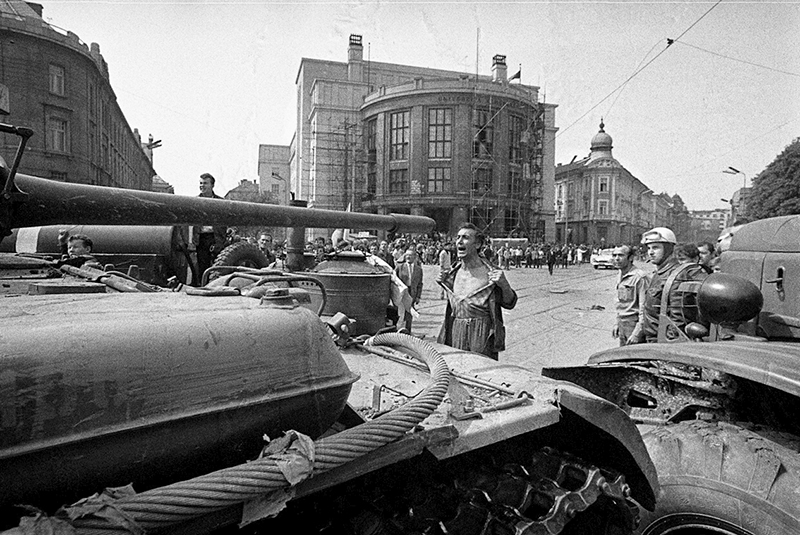
Perhaps the most recognisable example of protest undressing is captured in Ladislav Bielik’s photograph of a man peacefully protesting the Soviet occupation on Czechoslovakian streets in 1968. The image shows him ripping open his shirt to reveal his bare chest, presenting it defiantly to an oncoming tank. His shirt rending is equivalent to the gesture of a raised fist, expressing a pent-up anger so overwhelming that it can no longer be contained internally, and is forced out of the body in the form of a visible gesture. When a bare chest is pressed against a canon, as in Bielik’s photograph, the stark inequality seems unfair. The conflict is revealed as unjust, with the opponents clearly presented as victim and oppressor.

Such gestures appear to transform the sight of a fragile, exposed body into a show of raw force, with the power to overcome the might of opposing forces.


Naked power

By undressing in public, protesters assert what little power they still have. Undressing is not just a means of removing clothes, but a meaningful gesture that expresses a shift in attitude from compliance to defiance. At the same time, it is a direct challenge to those, like Trump, who are prone to objectifying the female body.

Nakedness has been employed for similar purposes by Femen, in protests against objectification, specifically the feeling that women have been “stripped of ownership” of their own bodies. Femen exploit the power of nudity to counteract “ornamental meanings of female nakedness”, though not because they feel that nudity has innate power; they achieve power via, not through, naked flesh. These protesters present the body not as a passive, erotic object, but as an unpredictable, intimidating Other.

The otherness of the female form is dependent on its unfamiliarity. Historically, the female body has been strange and mysterious, and as a result have been the subject of numerous myths and misconceptions, some of which persist in the US today.

Women in Los Angeles demonstrate against the election of Donald Trump. Mike Nelson/EPA

Women of past centuries have been able to exploit the perception of their bodies as peculiar or even monstrous. The Irish legend of Cú Chulainn, for example, describes how, when he turns against his uncle King Conchobor during a bout of youthful revolt, the king sends out a company of women to “expose … their boldness to him”. The young warrior is so intimidated by what he sees that he retreats. Similarly, in Jean de La Fontaine’s The Devil of Pope Fig Island (1674), a woman is able to ward of the devil by flashing her “gash”. Believing the woman’s “gash” to be a wound inflicted by terrible violence, the demon imagines that the woman’s husband must be even more monstrous than he, and retreats in fear.

When their male suppressors are ignorant of the female body and what it can do, women like these can exploit rumour and misinformation to de-eroticise their bodies.

That is not to say that a body must be de-eroticised in order to become powerful. Indeed, there is tremendous power in the erotic presentation of the body, as any burlesque performer will attest. The upcoming World Burlesque Games will demonstrate how empowering it can be to invite objectification in the right setting. Audiences and performers of neo-burlesque locate striptease in a post-feminist world, in which bodies of all shapes, sizes and genders deserve to be the subject of an erotic gaze.

Anti-Trump protesters reveal that this post-feminist ideal is still a distant dream for mainstream America. The mere fact that their nudity attracts press attention is evidence that the US still lags behind more liberated parts of the world in their approach to female nakedness. If the Trump administration does set back feminism, as so many fear it will, naked protest will continue to be an appropriate and effective tool for America women over the course of his presidency. So long as the administration objectifies the female body, protesters will be able to use their own bodies to confront the status quo.
The Conversation

Barbara Brownie, Senior Lecturer in Visual Communication, University of Hertfordshire
This article was originally published on The Conversation. Read the original article.

Monday, 23 May 2016

Grunts & Grapples Exhibition

Grunts & Grapples Exhibition      
Tunbridge Wells Museum & Art Gallery (15 September 2016 – 14 January 2017)

‘Greetings Grapple Fans!’ Kent Walton

For those of a certain age (and one could argue class), Kent Walton’s welcome will evoke the routine of Saturday tea-time’s in front of the TV, anticipating an exciting 45mins of grapples, grunts, and the ubiquitous incensed Granny scolding a wrestler. While wrestling was first broadcast on newly launched ITV station in 1955, its established slot (just before the football scores) came about with the launch of World of Sport a decade later in 1965, and would last for 24 years before being axed by the then Director of Programmes, Greg Dyke, in 1989. The magazine format sports show was originally intended as a direct response to BBC’s Grandstand, and ‘The Wrestling’ became a central feature of its programming. Part sport, part entertainment, at its peak wrestling garnered audiences of over 12 million, and the new commercial station seemed like a fitting home for a pastime that had emerged from the traditions of the music hall. Yet, in many ways, the balance between these two areas was always an uncertain one, and the pull towards celebrity and spectacle that the commercial element of the sport demanded, would eventually be wrestling’s downfall (at least in the UK).


Grunts & Grapples seeks to explore this much neglected area of social and cultural history. It is drawn primarily from my own personal collection of posters, photographs, programmes, and a handful of wrestling outfits. The aim of the exhibition is very much one of capturing how central the sport was to British life for most of the second half of the twentieth century and how it drew on earlier traditions of public entertainment. For example, in terms of design, there are various billposters, which in style reveal wrestling’s origins in the aforementioned music hall tradition, but also to those of the circus. The influence of these two forms of popular culture ran throughout the sport, from the portrayal of the wrestlers as baddies (‘heals’) or goodies (‘blue eyes’), to the widespread encouragement of audience participation. In terms of the wrestlers themselves, prevailing narratives of Otherness and racial stereotypes would commonly be utilised in the creation of personalities. Hence, you would have Johnny Kincaid and Dave Bond wrestling under the name the ‘Caribbean Sunshine Boys’, although as Kincaid noted in a recent BBC documentary, he had never been further than Wandsworth! Other such figures included the supposed Native American ‘Billy Two Rivers’ who would perform an “Indian” dance before each bout. And most famously, Kendo Nagasaki, who drew on popular imagery of ‘Japan’, in his use of Samurai swords and distinctive masks, all of which were frequently embellished by Kent Walton’s commentary on Nagasaki’s ‘mysterious origins’. This Otherness served as a uncomplicated signifier of badness, while in this crude worldview, ‘whiteness’ functioned as shorthand for decency and righteousness. Not that this binary was fixed, as there were many wrestlers who throughout their career switched from a ‘heal’ to a ‘blue-eye’ and back again. This play of characters across the hundreds of venues that hosted the wrestling during the week, and on the TV screens on a Saturday afternoon, was a carefully choreographed storyline, with long running grudges, feuds, and resentments. All of which were stage managed by the wrestling promoter Joint Promotions, who held a near monopoly on the sport during the period Grunts & Grapples explores (1955 – 1990).


When ITV’s broadcasting of wrestling was cancelled in 1989, one of the arguments appeared to be that the contrived storylines, larger than life characters, and manufactured bouts – the entertainment side of wrestling’s heritage - had overshadowed the sporting aspect. For many, the protracted battle between Big Daddy and Giant Haystacks throughout the 1980s served as prima facie evidence in the case for the prosecution. Judged as a mockery of ‘real’ wrestling – with the notorious 1981 Wembley clash contest lasting just 2mins 30secs – many fans and wrestlers alike considered the absence of skill and technique a step too far. With the arrival of Sky TV and the import of World Wrestling Federation (WWF) from America, it appeared such opinions were shared by Greg Dyke. Following its cancellation, wrestling continued in town halls and seaside piers well into the 1990s, but it never loomed as large in the public consciousness as it had throughout the 1960s, 70s and 80s.  


Friday, 19 February 2016

We have never been naked: insulation as a performing surface


On 30 January 2016, Eva Sopeoglou [1], Matina Kousidi [2] and Joanna Pierce [3] organised a multi-disciplinary collaborative workshop titled “We Have Never Been Naked: Insulation as a Performing Surface”. The workshop was part of Unfrozen – First Swiss Design Network Research Winter Summit symposium, held at Grandhotel Giessbach Brienz, Switzerland between 28-31 January 2016.


This Textile and Architectural multi-disciplinary international collaboration came together to explore the boundaries between space and insulation materials relating to both buildings and bodies. Set in the beautiful but cold environment of the Swiss Alps with snow capped peaks in the background, the workshop explored the subject of insulation properties through environmental installation, material exploration, collage, situation and action, as well as a range of senses; to formulate, experience and respond to sub-zero temperatures. 


Each presenter shared their expertise on the topic. Eva Sopeoglou’s research on human thermal comfort juxtaposed the physical need to protect the body from cold with the perplexing delight in experiencing a variety of temperatures, reminding that feeling cold and warm is a state of mind.

Matina Kousidi delved into the rich history of links between architecture and fashion and their overlapping interest to cover, house and protect the body, concluding that 'environments may be fit for human beings by any number of means'. 

Joanna Pierce introduced the processes that textile designers employ in order to manipulate and transform textile surfaces – folding, wrapping, knotting – and explained the many ways that textiles can perform in fulfilling ritualistic, technical and ecological purposes.


Participants were asked to address the research question of the role of insulation for the body and the built environment. They were prompted to respond with a piece of ‘performance architecture’, for example, a piece of clothing or a site-specific architectural enclosure – to be worn by one or many. The performances included a piece of spoken word, text narration, discussion, acting, staging. 

The proposals considered insulation alongside the collective or the sublime experience of cold environments. For example, body warmth can become social, a shared means to spend time outdoors, even among strangers. A ‘duvet wall’ can facilitate conversation between people at a bus stop. A site-specific outfit which includes built-in insulation, furniture, a garment and goggle accessories can allow one to delight in a multi-sensory panorama of a wintery landscape. 

The workshop prompted everyone to continue their pursuit to design fit environments for human activities. At the same time, this winter symposium was excellent excuse to delight in the cold.

This workshop was partly funded by a University of Hertfordshire - Santander Small Grant for Multi-disciplinary Research.

--------------------------------
[1] Eva Sopeoglou is Lecturer of Architecture and Interior Architecture and Design at the University of Hertfordshire.
[2] Dr. Matina Kousidi is a Research Fellow in Architecture and Urban Studies at the Politecnico di Milano.
[3] Joanna Pierce is Senior Lecturer, Print Pathway Leader and Researcher at the Textile Futures Research Centre, Central St Martins, University of the Arts London.