Showing posts with label representation. Show all posts

Thursday, 7 June 2018

Between ‘Revere’ and ‘Remove’

Students on the DHeritage programme at University of Hertfordshire met for one of the regular programme of workshops on 14th May 2018. Convened by Professor Sarah Lloyd, the programme for the day focussed on the concepts of ‘Remembering and Forgetting’.  It brought together students and staff at UH involved in the DHeritage with several external speakers addressing issues of ‘memory’ within their research. The day covered issues of migration (Dr Eureka Henrich), slavery (Dr Jessica Moody) and the heritage of tomorrow (Dr Esther Breithoff) in addition to contributions from students dealing with these questions in professional practice.

By chance, the workshop coincided with one of a series of evening debates organised by Intelligence² and Historic England and held in Westminster Revere or Remove? The Battle Over Statues Heritage and History’. This discussion, led by historians and journalists, addressed the subject of memory, and how such a contested concept is dealt with publicly, particularly in the multicultural and multi voiced 21st century context.

Managed by Jonathan Freedland, Guardian columnist and author, the Panel comprised Peter Frankopan, Research Fellow at Worcester College, Oxford; writer and broadcaster Afua Hirsch; author Tiffany Jenkins, Honorary Fellow at the University of Edinburgh; and David Olusoga, Historian and Broadcaster.  Each presented a position statement generated initially in response to the ‘Rhodes Must Fall’ campaign (https://rmfoxford.wordpress.com), which has recently campaigned to remove a statue of Cecil Rhodes from Oriel College in Oxford, and the decision to remove a statue of confederate general Robert E Lee from a park in Charlottesville, USA.  In many ways the responses and positions described were personal and reflected the experiences of the speakers.  Olusoga spoke with passion about the statue of merchant and slaver Edward Colston in Bristol, contrasting his own confidence in dealing with such memorials with that of others without his depth of historical knowledge.  He deconstructed the purpose of such statues and demonstrated both their erroneous portrayal of history and the changing nature of their meaning in contemporary society.  He urged the removing of Colston to a different site where his legacy could be debated in a context based on learning, not on the reverence that is hard to avoid when a viewer is physically required to ‘look up’ to a statue.  Jenkins took the position that relocation of statues simply relocated the issues. She noted the poor aesthetic quality of many such memorials and invoked the concepts of current relevance and the passing of time as determinants of the appropriate actions and responses to memorials.  As the contested statues are primarily in public places, her position was to leave responsibility with the public.  Where memorials are wanted they will be cared for, where no longer relevant they will be neglected and decline.  This approach reflects an emerging debate within the museum and heritage world regarding the potential for ‘managed decline’ of objects and places which are difficult to maintain for a range of reasons.  The need to forget as well as to remember was referenced although in a situation where the issues which some statues symbolise clearly continue to remain unaddressed, it seemed premature to move directly from ‘revere’ to ‘remove’ without further consideration.


All of the panellists at some point found themselves at risk of entanglement with the intricacies of this debate.  Hirsch urged the removal of the statue of Cecil Rhodes but also described the importance of monuments as part of the relationship of the present with the past.  Frankopan offered the view that the ‘winds of history’ mean that all statues will eventually fall, and that indeed, it is their ultimate function.  All felt that there should be some critique of each circumstance and a greater understanding of the history that each monument represents.  While an obvious response to the situation under discussion, this led inevitably to a discussion of the limitations of history teaching and public knowledge and to the fact that many statues are symbolic reductions of complex situations.  Their original meanings may have been lost and may be of limited relevance for the majority of those who view them today.  While some statues have little meaning at any one time, some have disproportionality significant meaning, becoming symbols of contemporary concerns. Olusoga pointed out that the Bristol statue of Colston was erected two hundred years after his death.  In this situation is the statue more realistically considered as something of the 19th rather than the 17th or 18th century?  Jenkins in particular cautioned about the dangers of being ‘enslaved to the past’.  If Bristol was provided with a statue of Colston in the 1890’s as part of a battle for power within the city’s merchant class, then it seemed entirely possible by the end of the debate that by removing it, Bristol could be signifying a sense of itself for the future, not seeking to remove an unpleasant figure and an unpalatable sense of its past.

Edward Colston, Bristol ©Barbara Wood

Reflecting on the workshop and the evening debate it seems as if the issues of both were less concerned with the meaning of statues and memorials at the time of erection and more about their function in establishing new identities for places and for society for the future.  A contributor from the audience, part of a campaign group aiming to remove the Colston statue spoke about the fundraising to establish a memorial to the 32000 people who died because of Colston’s’ activities and a museum of slavery in Bristol.  Meaning changes and develops even within living memory. Centuries after they were established, many of the remains under discussion seem inconsequential in themselves. It was their currency in the present that was important. It is surely our opportunity and responsibility to erect statues and memorials to what is important today, if - as Frankopan pointed out - anybody is interested enough to do that. 

Barbara Wood
Doctoral Candidate (DHeritage Programme)
@CuratorSW 

References
DeSilvey, C. (2017) Curated Decay Heritage Beyond Saving. University of Minnesota Press.

Jenkins, T. (2016) Keeping their marbles How the treasures of the past ended up in museums and why they should stay there. Oxford University Press. 

Friday, 7 July 2017

TVAD Talks 2017/18 - New Series Launched!

The TVAD Talks for the coming year are now scheduled on Wednesdays as follows. All are welcome. Please add these dates to your diaries. Lunches are provided so please confirm your attendance with Antoine Proust, a.proust@herts.ac.uk a couple of days beforehand, for catering numbers. We look forward to an exciting series of discussions!


Weds 11th October 2017 – Sahar Khajeh (University of Hertfordshire), ‘Kinetic Typography as a potential solution to the needs of bilingual typography (Arabic and Latin script)’


The aim of the discussion is to demonstrate how Kinetic typography could solve the problem of bilingualism where we need typography that works for two languages (Arabic and Latin scripts) specifically outside of printing environment. Examples include demonstration of bilingual logos on shop signage, presenting of tourist guidelines in airports and road signs or exhibiting the translation of a word where these two different cultures are mixed. Before we can discuss bilingual typography, we need to establish an agreed terminology for discussing similarities and differences between the two different written scripts. Due to lack of a proper Arabic Script’s nomenclature system, a system of classification and nomenclature for Arabic letterforms needs to be compatible with terminologies used to describe Latin script. During the current phase of my DDes, course I am examining the terminology in current use with the aim of being better able to compare the two scripts.

 
Weds 15th November 2017– Dr Thom Cuschieri (University of Hertfordshire), ‘The Gorey Groan – A Study in Gothic Voices’


In Jorge Luis Borges’ short story Pierre Menard, Author of the Quixote (1939), a twentieth-century French writer endeavours to reproduce Cervantes’ seventeenth-century masterpiece Don Quixote – not by memorising the original, but by so fully inhabiting Cervantes’ life and persona that he is able to recreate the work anew, from scratch. Borges’ wry reflection on the nature of authorship and the appropriation of style and voice is the inspiration for The Gorey Groan, which seeks to explore similar concerns at the heart of illustration. 

Through a stratagem similar to that used by Borges’ eponymous, fictional Menard, this project seeks to gain insight into the work of two twentieth-century artists intimately connected with the gothic tradition: the American writer, illustrator, and designer Edward Gorey (1925 – 2000) and the English writer and illustrator Mervyn Peake (1911 – 1968). The project involves a meticulous study of Gorey’s visual language, style and approach, and will include the production of a series of illustrations “by Gorey” (in the Borgesian sense) of Mervyn Peake’s gothic novel Titus Groan, as a means of engaging meaningfully with both artists’ oeuvres.


Gorey did not illustrate Titus Groan in his lifetime, and the focus here is not the replication of an existing body of work, but rather the means by which artists create their voice, through conscious borrowing and subconscious influences. There is, of course, a third voice in this project – my own – and, unlike Menard, I aim to scrutinise my role in the shaping of Gorey’s authentic “voice” as I seek to experience Peake’s text through a particular artistic vision.


Top: From 'The Object Lesson' (Edward Gorey)
Bottom: Sketch of Titus on horseback (Mervyn Peake)     


Weds 6th December 2017 - Peter Thomas (Middlesex University) and Prof Grace Lees-Maffei (University of Hertfordshire), ‘The Poster Session as Fusing Theory and Practice in (Art and) Design Education: Exhibiting an Occluded Genre’

This talk presents our research on the pedagogical benefits of poster sessions for teaching contextual studies in design education. The academic poster has been used most extensively in the sciences, but we argue that its particular pertinence in design education is undervalued to date. Design students have visual and design skills which can be applied to the production of a poster, but also their verbal experience of speech acts such as ‘crits’ (studio evaluations) and speaking to design outputs in a client pitch can be applied in the talk which takes place in poster sessions. Because the production of posters and the poster sessions where they are displayed and discussed draw on skills which students use in the studio, they have the capacity to bridge theory and practice when used in contextual studies for design students, in content, form and process.

Much of the secondary pedagogical literature on posters is fundamentally about ‘how-to’ design a poster; it is instructional. Our focus here is, rather, on the pedagogical affordances of the poster and poster session. While the how-to material focuses on the production of an outcome, our approach focuses on the poster as process, bridging theory and practice and affording a site for talk. The instructional approach we deem as being principally of benefit to the learners / makers of posters, and the learning benefits we expect to be of interest to teachers, as well as learners to some extent.


Posters are, in some senses, what Swales calls an 'occluded genre', in that they are often used to support the development of a higher stakes text, and in these cases are to an extent comparatively hidden. Our students have found the process of research and making a poster, talking about it and talking to other students about their posters in dedicated poster sessions to be very useful in developing ideas, and learning to express their ideas, about contextual studies topics as part of the preparation for an essay. We base our talk on primary pedagogical research we have conducted with undergraduate design students in two North London universities and with postgraduate students of design cultures in a Dutch university, and a review of the relevant secondary literature across a number of academic disciplines.

Weds 7th February 2018 – Dr Sorcha O’Brien (Kingston University), ‘Electric Irish Homes: Rural Electrification, Domestic Products and Irish Women in the 1950s and 1960s’ (Title, Abstract TBC)

Dr O’Brien will discuss her Arts and Humanities Research Council-funded project which runs from 2016 to 2019. It looks at the effects of rural electrification on rural Irish housewives and homes during the 1950s and 1960s, focusing on the importation, promotion, cultural context and significance of domestic electrical products and their meaning to a generation of rural housewives. Although electric products for cooking or cleaning were seen as modernising and liberating technologies in other countries, this project will use archival research, object analysis and oral history to consider to what extent these meanings held for Irish women, particularly against the background of Irish establishment attitudes to the role of married women as domestic housewives. As the rural electrification project of the Electricity Supply Board (ESB) was rolled out across the State, the majority of domestic electrical products such as irons, fridges or vacuum cleaners were largely imported from Britain, Europe and the United States, and the project will look at the specifics of product ranges available in Ireland, and consider the implications of ‘modern’ influences from outside the state, particularly before the Scandinavian Report on Irish Design (1962) kick-started the native design industry in the late 1960s and 1970s. Outputs include a monograph, journal articles, and an exhibition in the National Museum of Ireland Country Life, accompanied by a series of creative workshops. The project has also been supported by a Design History Society Research Travel Grant, 2015 and the Fundació Història del Disseny 2nd Alfaro Hofmann Collection Research Grant for the Study of Domestic Appliances: The Vacuum Cleaner, 2015. Read more about it on the project website: https://electricirishhomes.org


Weds 14th March 2018 – Dr Claire Jamieson (University of Hertfordshire), ‘The deindustrialising city as site, symbol and material for design’

This talk will explore a milieu of 1980s British design across architecture and product design that can be characterised by a preoccupation with material salvage, DIY processes of making, an antipathy to mass-modernism, and a post-industrial urban aesthetic. Building on my monograph about the radical architectural group NATØ, this work expands the scope of my investigations into related design disciplines in order to more fully interrogate a period preoccupation that I argue emerged from the distinct urban condition of deindustrialising London. Through an examination of the work of designers including Ron Arad, Tom Dixon and his Creative Salvage group, Danny Lane, Daniel Weil, as well as Nigel Coates and NATØ, and some more tentative links to fashion and graphic design, I will identify a postmodern attitude to design as bricolage and a form of street vernacular.

The decline of London’s urban fabric during the 1970s and 1980s was dramatic and traumatic ­– with vast swathes of the city lying derelict as the it prepared to be reshaped in a new post-industrial era. I will show how the unfamiliar material conditions and destabilising spatial relationships produced by deindustrialisation spurred a new form of creative imagination. London’s ruinous landscape suggested, and indeed provided, the physical materials for this new language, but also evoked an attitude that was translated into ad-hoc, primitive objects that resisted mainstream design culture. Furthermore, empty and derelict buildings provided the space for these works, which were often constructed using industrial techniques, to be made. For the Creative Salvage group, music culture formed an important part of this making process – with huge parties held in abandoned buildings illuminated by the welding iron and the angle grinder. My work brings research on the nature of post-industrial urban landscapes from urban studies into the realm of design history in order to better understand the influence of urban decline on a generation of designers.

With a line of influence that can clearly be traced back to the DIY practices of punk, the improvised and often purposefully ‘anti-design’ nature of these works blurs the boundary between professional and amateur. NATØ described an ‘apprentice’ character – an impoverished maker who could scavenge, construct, sell, swap, repair and fix their environment. Further, untrained designer-makers such as Tom Dixon, who produced hand-wrought one-off objects, put forward a model of practice that falls between art, design, and craft. My talk will expose these complex relations which problematize the role of the professional architect or designer who works in this mode.


‘One Off’, Ron Arad’s studio/shop, (1982)
‘Albionize Your Living Room’ from NATØ, (1984)

For more information, contact Dr Grace Lees-Maffei g.lees-maffei@herts.ac.uk

Monday, 6 March 2017

In and Out of Sight: Catherine Bertola, Cath Campbell, Jo Coupe and Jennifer Douglas

Two TVAD researchers, Dr Barbara Brownie and Dr Grace Lees-Maffei, are involved with events supporting this new exhibition at UH Galleries, which runs from 18 March - 6 May 2017 in the Art and Design Gallery, College Lane, Hatfield.

UH Galleries tells us that "In and Out of Sight is a dynamic exhibition encompassing drawing, sculpture, film, installation and live works by four artists from the North East of England. Performance is the starting point for this new work and, while none of the artists  would describe themselves as performers, increasingly they are realizing the role of performance inherent in the research, making or presentation of their work."  Read more...

Get Involved:
Round Table with Catherine Bertola
Thursday 27 April, 1-2.30pm, Art and Design Gallery
Join us for an informal discussion with Catherine Bertola and historians Dr Grace Lees-Maffei and Dr Rachel Rich about the performative nature of domestic space. Booking not required. FREE!
Closing Event with Artists' Talk
Tuesday 2 May, 4-7pm, Art and Design Gallery
You are invited to a celebratory viewing of this evolving exhibition as it draws to a close. All four artists will be in conversation with writer Lizzie Lloyd from 4-5pm. Booking not required. FREE!
Read our blog! 
uhartsresident.wordpress.com
You can follow the development of the exhibition and read interviews with the artists and articles discussing the themes of the exhibition on our dedicated blog written by Dr Barbara Brownie.
Sad Bones (unknown interior #3), Catherine Bertola 2013
Copyright © 2017 UHGalleries, All rights reserved. Image courtesy of the artist and Workplace Gallery
Contact:
UH Galleries
UH Arts 
University of Hertfordshire
Hatfield, Hertfordshire AL10 9AB
United Kingdom.

Wednesday, 8 February 2017

TVAD Talks 2017 Update

TVAD hosts monthly research seminars, TVAD Talks, on the second Wednesday of each month during term time. A couple of changes have been made to the programme, so an update is timely. Please find details of the final three TVAD Talks for the 2016-17 academic year. TVAD Talks take place at 12.45 for 1 pm in room 1A159 (Lindop Building, College Lane campus), with a budget lunch provided. All are welcome to attend - please RSVP to the TVAD Research Group Leader, Dr Grace Lees-Maffei, g.lees-maffei@herts.ac.uk for catering purposes.


Weds 8th February 2017 - Femke de Vries, HKU University of the Arts Utrecht, (www.FemkeDeVries.com) ‘DICTIONARY DRESSINGS: Clothing definitions decoded and translated towards alternative fashion perspectives’. Respondent: Professor Rebecca Houze, Northern Illinois University.

Dictionary definitions are generally experienced as factual and rational and in the case of clothing show no connection to the mythical character of fashion. They describe the characteristics of the items, the modes of use and/or the relation to the body but fashion or style is not mentioned. For example: “Handschoen: bekleding van de hand” (Literally translated to English as Glove: covering of the hand). It becomes clear that a hand can be covered by putting it in a pocket, by bandaging it or by sitting on it, turning a pair of trousers into a glove for they cover the hand and therefore suffice to the definition.In this on-going project the nature of the dictionary definition as a ‘zero condition’ of a piece of clothing is used not to find a general truth of a piece of clothing, but to re-read clothes and explore an alternative fashion vocabulary. This vocabulary will take the shape of an image archive, theoretical and design-led approaches by experts and students brought together in a publication, website, workshops and catalogues of these workshops.

Femke's TVAD Talk is available to view on 
 the University of Hertfordshire's YouTube Channel, in the Creative Arts Research playlist


Weds 15th March 2017 – Dr Grace Lees-Maffei, University of Hertfordshire, ‘The Written Object’


Words are constantly present throughout the design lifecycle. They accompany the design process, in formal client briefs, in informal exchanges between members of design teams, in CADCAM software and specifications. Words are used to market and advertise designed objects, images, and services. We use words to describe what we do within, and how we feel about, the designed environments in which we all exist. 

These verbal processes have been recognised to some extent by design historians in the field’s recent mediation turn. Since the Production-Consumption-Mediation paradigm was posited in 2009, new research has emphasised the importance of words in understanding design. Design journalism, for example, has been critically important in shaping the ways in which we conceive of, and consume, design. And web 2.0, for instance, has complicated the notions of authority upon which design journalism and design criticism have existed. Bloggers and vloggers are now recognised as prime influencers, and their influence extends more and more into mainstream media. 

We can identify some new directions for the study of the written object, or more inclusively, words and design. A small number of design historians are beginning to examine design journalism as worthy of academic analysis. The relationship between design and literature has so far remained largely untouched by design historians. Literary sources do not rely for their status, influence and authority upon the veracity with which they describe design, but they have a great deal to tell us about design, and design of the past. By the same token, we might examine the literary and aesthetic merit of design criticism and design journalism. Finally, I post a rhetorical question: Is it possible to communicate about design in a non-verbal way?

TVAD Talks are filmed for the University of Hertfordshire's YouTube Channel, in a Creative Arts Research playlist Here is Lees-Maffei's presentation, 'The Written Object':


Weds 10th May 2017 – Dr Nicolas P. Maffei, Norwich University of the Arts, ‘The Responsive Brand: Uniformity and Flexibility in Logo Design’


From the uniformity of modernism to the embrace of difference, this talk explores the historical shift from static to dynamic logos, from universal international brand identities to more flexible and responsive corporate personalities. This transformation occurred over a period extending from the nineteenth century to the present, and includes the roots of branding, the ideals of modernism, the emergence of the critical consumer, the development of the responsive corporation, and the co-creation of brands in online landscapes. From Peter Behrens’ designs for the German Allgemeine Elektrizitäts-Gesellschaft (AEG), in 1907, considered the first corporate identity, to Paul Rand’s flexible and humanizing identity developed for International Business Machines Corporation (IBM) after WWII, this talk reviews the rise of the unchanging logo and, in turn, the multivalent brand-mark. In addition, the design responses of corporations to the vocal and ethically informed consumer are surveyed via the anti-branding movement, which has targeted Starbucks and McDonalds among other corporations. Nike is examined through local reinterpretations of the global brand. Gap’s failed logo of 2010 shows the power of the online consumer and the need for companies to listen and respond. Finally, brand reactions to the responsive consumer – characterized by chameleon-like logo transformation and an emphasis on user interaction and co-production of meaning, are investigated through the designs for telecommunications company Ollo (Bibliothèque, 2012), the identity for the Tate museums (Wolff Olins, 1999), and Experimental Jetset’s Responsive ‘W’ for The Whitney Museum (2011).

For more information, Contact Dr Grace Lees-Maffei, TVAD Research Group Leader and TVAD Talks Convenor, g.lees-maffei@herts.ac.uk 


Thursday, 1 December 2016

Adventures in the Classroom - Responding to the UH Strategic Plan 2015-20: Global Perspectives in the Curriculum


Dr Ivan Phillips and Kim Walden - School of Creative Arts, University of Hertfordshire


There has been much debate this year about what kind of relationship Great Britain wants to have with Europe, and indeed with the rest of the world: from the lofty aspirations of the Higher Education Academy’s framework aim to ‘internationalise higher education’ to the stark realities of the Brexit referendum result in June.


At a more local level when the University of Hertfordshire published its own strategic plan with a focus on global perspectives in the curriculum, teaching staff in the School of Creative Arts Critical and Cultural Studies (C&CS) Network set out to explore what it means in the classroom.

Each Network member was invited to choose one picture which articulated how they addressed the objective in their day-to-day teaching practice. The results were thought-provoking and so was the discussion that ensued.

Read more about it in a thought piece written for LINK journal here: https://www.herts.ac.uk/link/volume-2,-issue-2/global-perspectives-in-the-curriculum


Tuesday, 29 November 2016

Why nakedness is an apt way to protest the Trump presidency

Barbara Brownie, University of Hertfordshire

Donald Trump’s road to the White House has been punctuated by as series of naked protests, ranging from topless women at Trump’s polling station to Spencer Tunick’s nude installation of 130 naked protesters outside the Republican National Convention in Cleveland. These protesters continue a long history of naked demonstration – and nakedness has long been employed as a gesture of defiance, highlighting the plight of the oppressed.

In a time when media is saturated with nudity, the naked body might seem to have lost its power. But amid fears that Trump’s administration will set back women’s rights by decades, naked protest may have regained relevance.

When 100 semi-naked protesters marched to Trump Tower on November 19, some presented their bodies as metaphors for the human planet, sensitive to climate change. Others used their bodies to express a fear that women, under Trump, would become a marginalised group. These protesters’ nudity is a defiant response to revelations during Trump’s campaign about his attitudes towards imperfect bodies, confronting Trump’s “man of the people” act by showing him what real America looks like. If Trump is to represent “ordinary Americans”, he must learn to accept them in all shapes and sizes.


But these were more than just naked bodies. Protesters had decorated their bodies with fake wounds and scars, representing the damage that Trump’s administration may cause. This is a warning that if the administration wields too much power, the powerless will suffer.

Trump’s election has left many Americans feeling overwhelmingly powerless. It would make sense, then, for them to resort to a method of protest that has long been associated with oppressed and minority groups. Undressing is a tool that is at almost any protester’s disposal: a last line of defence that is almost universally accessible. It is an act of defiance that is still available even to those who are disempowered by low status, by lack of funds, or simply by ordinariness. So Mexican farmers protesting government appropriation of their land in 1992 turned to naked protest as a last resort, explaining their action by saying “we are stripping because … we don’t have money to buy an ad in the news … we have no other arms, all we have are our bodies”. This movement, which became known as the 400 Pueblos, continues sporadically to this day.

Members of the social group 400 Pueblos (400 towns) protest in 2005. Iván Stephens/EPA

Human conflict is predicated upon the relational power of opposing parties. Power often stems from control of tangible resources, but is also exercised symbolically, through bodily gestures. Foucault’s writing on subjugation equates power to control of the body. In times of conflict, dominance is asserted through actions that demonstrate control over the “docile” bodies of others. Conversely, to evidence control over one’s own body in the face of an enemy is to maintain control over one’s dignity and identity.

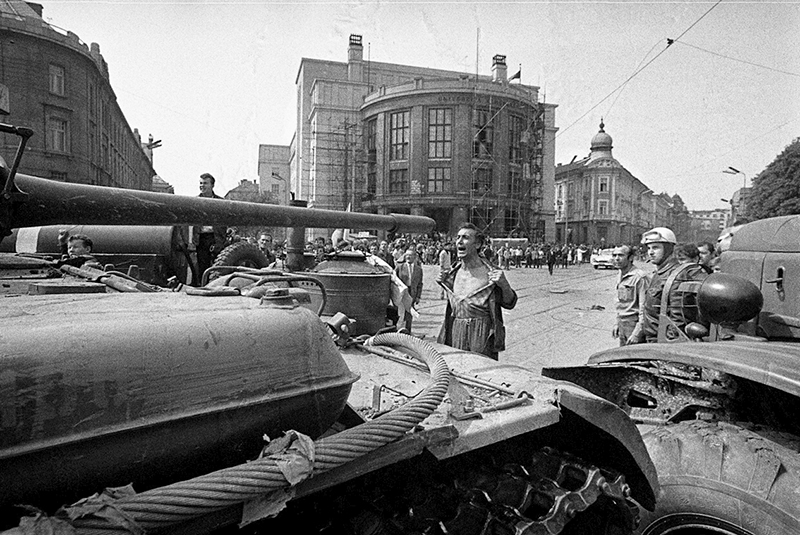
Perhaps the most recognisable example of protest undressing is captured in Ladislav Bielik’s photograph of a man peacefully protesting the Soviet occupation on Czechoslovakian streets in 1968. The image shows him ripping open his shirt to reveal his bare chest, presenting it defiantly to an oncoming tank. His shirt rending is equivalent to the gesture of a raised fist, expressing a pent-up anger so overwhelming that it can no longer be contained internally, and is forced out of the body in the form of a visible gesture. When a bare chest is pressed against a canon, as in Bielik’s photograph, the stark inequality seems unfair. The conflict is revealed as unjust, with the opponents clearly presented as victim and oppressor.

Such gestures appear to transform the sight of a fragile, exposed body into a show of raw force, with the power to overcome the might of opposing forces.


Naked power

By undressing in public, protesters assert what little power they still have. Undressing is not just a means of removing clothes, but a meaningful gesture that expresses a shift in attitude from compliance to defiance. At the same time, it is a direct challenge to those, like Trump, who are prone to objectifying the female body.

Nakedness has been employed for similar purposes by Femen, in protests against objectification, specifically the feeling that women have been “stripped of ownership” of their own bodies. Femen exploit the power of nudity to counteract “ornamental meanings of female nakedness”, though not because they feel that nudity has innate power; they achieve power via, not through, naked flesh. These protesters present the body not as a passive, erotic object, but as an unpredictable, intimidating Other.

The otherness of the female form is dependent on its unfamiliarity. Historically, the female body has been strange and mysterious, and as a result have been the subject of numerous myths and misconceptions, some of which persist in the US today.

Women in Los Angeles demonstrate against the election of Donald Trump. Mike Nelson/EPA

Women of past centuries have been able to exploit the perception of their bodies as peculiar or even monstrous. The Irish legend of Cú Chulainn, for example, describes how, when he turns against his uncle King Conchobor during a bout of youthful revolt, the king sends out a company of women to “expose … their boldness to him”. The young warrior is so intimidated by what he sees that he retreats. Similarly, in Jean de La Fontaine’s The Devil of Pope Fig Island (1674), a woman is able to ward of the devil by flashing her “gash”. Believing the woman’s “gash” to be a wound inflicted by terrible violence, the demon imagines that the woman’s husband must be even more monstrous than he, and retreats in fear.

When their male suppressors are ignorant of the female body and what it can do, women like these can exploit rumour and misinformation to de-eroticise their bodies.

That is not to say that a body must be de-eroticised in order to become powerful. Indeed, there is tremendous power in the erotic presentation of the body, as any burlesque performer will attest. The upcoming World Burlesque Games will demonstrate how empowering it can be to invite objectification in the right setting. Audiences and performers of neo-burlesque locate striptease in a post-feminist world, in which bodies of all shapes, sizes and genders deserve to be the subject of an erotic gaze.

Anti-Trump protesters reveal that this post-feminist ideal is still a distant dream for mainstream America. The mere fact that their nudity attracts press attention is evidence that the US still lags behind more liberated parts of the world in their approach to female nakedness. If the Trump administration does set back feminism, as so many fear it will, naked protest will continue to be an appropriate and effective tool for America women over the course of his presidency. So long as the administration objectifies the female body, protesters will be able to use their own bodies to confront the status quo.
The Conversation

Barbara Brownie, Senior Lecturer in Visual Communication, University of Hertfordshire
This article was originally published on The Conversation. Read the original article.