At a recent UHArts panel discussion, Catherine Bertola was joined in discussion by Rachel Rich, senior lecturer in history at Leeds Becket University. Bertola and Rich are currently benefitting from a
Leverhulme Trust Artist in Residency award that has enabled them to share ideas related to the domestic interior. The panel discussion was an opportunity to examine Bertola's past and current work in relation to 19th Century cookbooks and domestic advice manuals, and for staff and students at the University of Hertfordshire to respond with their own questions and observations about Bertola's work.
Much of the discussion focused on the staging of domestic spaces, in their original, domestic use, and when preserved for display, as in the Bronte Parsonage Museum, where Bertola created a series of photographs entitled
Residual Hauntings (2011). Bertola is critical the staging of historical spaces, noting the inauthenticity of the objects and decor that are often used in such staging, as well as the artificiality of preserving a space as if frozen in any one particular time. Rich draws parallels with the staging of domestic interiors in the 19th century, and the performance of hospitality that was advised by domestic advice literature of the time. Publications including
Mrs Beeton's Book of Household Management propagated the idea of the home as an "enterprise" that could be "run for the success of the family unit", and presented an impossible ideal against which Victorian women could measure the success or failure of their domestic activities.
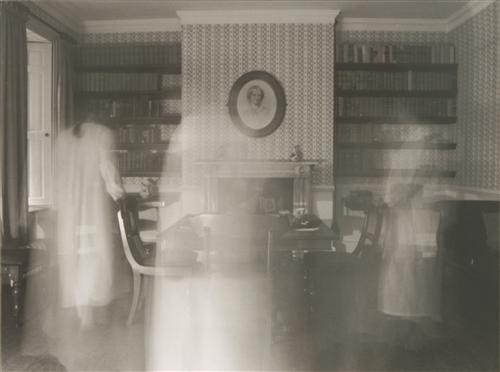 |
| Residual Hauntings, 2011 |
Rich relates some of Bertola's past works to the ideals advocated in these manuals, including the "act[ing] out of their leisure time as a job". Bertola's
Killing Time (2011) shows the artist superimposed into photographs of domestic interiors, sipping from a teacup as if caught between domestic chores. Bertola's work with images of domestic interiors seems not to clearly differentiate between images of labour and leisure. It is interesting to consider Rich's reading of Bertola's work in relation to the writing of Erving Goffman. In his explorations of the “presentation of self in everyday life”, Goffman (1959, p. 69) identifies “backstage” events and locations, in which individuals engage in private activities in preparation for the everyday performance of self. The home is divided into spaces that are, to varying degrees, public or private. Bedrooms and bathrooms are distinctly private, drawing rooms more public, and hallways, Bertola notes, "transition between public space and private space". Rich observes that time spent in, and caring for, those domestic spaces is also divided into public and private time. "Backstage" activities that are the work of the domestic labourer are conducted in private, as a means of preparing for the public presentation of a space.
 |
| Killing Time, 2011 |
The preparation of Bertola's work has often involved private labour, in isolated spaces, leading up to the time of completion when the public are invited into the space. Working on
After the Fact (2006), she necessarily worked alone, in an abandoned building, sweeping dust from the floor to recreate patterns from eighteenth-century wallpaper. As she swept, she recorded the sounds of her labour in an audio track that now exists as a public record of her "backstage" activities. For an earlier work,
Scratching at the Surface (2001), she spent 2 weeks at the top of scaffolding, isolated from the street below, scratching through layers of paint on the exterior of a building in Newcastle upon Tyne. These private preparations are intentionally similar to the "backstage" labour that takes place in domestic spaces, incorporating sweeping, dusting and cleaning, and consciously isolating, drawing on the "idea of being trapped" that she associates with domestic labour. She develops a sense of ownership during her temporary inhabitation of these spaces, and must relinquish her ownership when the work is complete and the public come swarming into her erstwhile private space.
 |
| Scratching at the Surface, 2001 |
 |
| After the Fact, 2006 |
She has found that there is more privacy in the production of site-specific works than in galleries. Works produced for galleries, such as the work currently on display in the
In and Out of Sight exhibition at the University of Hertfordshire, can require her private processes to be transformed into public performances. While creating her current work on the wall of the Art & Design gallery, Bertola was exposed to passing visitors, students and the other artists with whom she shares the exhibition. It is interesting to note that the subject of this work is a photograph of a private domestic space, made public through a photograph that has been published in a readily-available publication.
Bertola and Rich's conversation often turned to the subject of time. Many of Bertola's works have involved
reviving old images, revealing surfaces lost to time, or bridging the gaps between periods. Bertola describes her work as "fleeting". Her site-specific work is necessarily temporary. It often has a "fragility", like the dust of
After the Fact, that can be swept away. Rich describes her "heartbreak" at imagining how easily Bertola's work can be brushed away. She draws parallels with the domestic labour that can be undone so easily, as clean spaces gather more dirt, and "the entrapment of women" in the neverending cycle of domestic chores (a cycle that is referenced in Bertola's
Round and Round, 2016, in which the artist is shown endlessly setting and unsettling a table). It was unusual for her to preserve her images by placing them in a frame, as she has done for
Sad Bones (2013-14), giving them a permanence that is not often present in her work.
Preservation, and the effects of time, were foremost in her thoughts when Bertola created
Everything and Nothing (2007) at the V&A. In this setting she became very aware of the rituals surrounding the presentation of collected artefacts, and the distinctions made between the labour of those who cared-for those artefacts, and those who cared for the museum's interior. She observed a hierarchy of cleaning, topped by the conservators responsible for cleaning the artefacts, skilled cleaners who are permitted to clean the plinths, and unskilled, "invisible" cleaners with responsibility for the floors. It is the unseen labour of the latter that is most directly referenced in Bertola's work, and that most fascinates Rich.
 |
| Everything and Nothing, 2007 |
Reference
Goffman, E. (1959), The Presentation of Self in Everyday Life, New York: Anchor Books.


