Showing posts with label Museums. Show all posts

Thursday, 10 January 2019

Zoë Hendon 'Working at the Intersection of Archives and Practice’

Next week TVAD is hosting a TVAD Talk research seminar by external speaker Zoë Hendon, Head of Collections and Associate Professor, Museum of Domestic Design and Architecture (MoDA), Middlesex University. Her TVAD Talk, entitled ‘Working at the Intersection of Archives and Practice’ will showcase her doctoral research in the context of her professional work at MoDA. Zoë’s talk will examine her approach to both:
the museum's collections from a design-historical perspective, and on the ways in which these collections inspire creative practice in the present. 
In this talk she will refer to various projects she has worked on in recent years, and reflect on where these different strands of thought are currently taking her. Zoë’s PhD ‘Looking Back and Looking Forward, the The Silver Studio Collection as heritage asset and educational resource, 1968-2018’ is registered with Middlesex University and is due for completion by end of 2019. The Silver Studio Collection
was a commercial design practice, which between 1880 and 1963 completed more than 20,000 schemes for items such as furnishing fabrics, wallpapers, tablecovers, rugs and carpets. The Studio answered the needs of its customers, who were retailers and manufacturers at all levels of the market. Many of its clients were mass producers and Silver Studio designs therefore found their way into numerous British homes.
Zoë’s recent publications arising from this project include:
  • ‘The Silver Studio art reference collection’ Decorative Arts Society Journal 36 (2012): 65–81;
  • The Silver Studio and the Art of Japan, Middlesex University: Museum of Domestic Design & Architecture (2014);
  • ‘Behind the Scenes at the Silver Studio : Rex Silver and the Hidden Mechanisms of Interwar Textile Design’ Architecture and Culture 6, 1 (2018): 61–80;
  • and, with Dr Linda Sandino ‘Inspiration Examined:Towards a methodology’ Art, Design and Communication in Higher Education 17, 2 (2018): 135–50.


    The talk will be filmed by Mikayla Laird and will be published on the University of Hertfordshire’s YouTube channel in due course. Further TVAD Talks are listed on the TVAD Talks webpage and on the TVAD blog.

Friday, 30 November 2018

TEG Tactile Access to Collections Workshop

In September 2018 I was awarded a small grant from the British Academy to support my research for The Hand Book for the next two years. As part of my project, I am blogging about my research here on the TVAD blog and on my own website www.graceleesmaffei.org 


Yesterday, I attended the Touring Exhibition Group (TEG) workshop Tactile Access to Collections: Maximising and Managing Public Object Handling Opportunities at The House of Illustration in London’s Kings Cross. This amazing building, at 2 Granary Square, was designed by Lewis Cubitt in 1850 as part of the Kings Cross Goods Yard. In 2014 it opened as the House of Illustration when the area was redeveloped.


TEG was set up when the Circulation Department of the Victoria and Albert Museum was closed down in order to represent smaller museums and advocate for the circulation of exhibits from larger and national museums to smaller regional venues (for an account see the Wikipedia page about the group, which was clearly written by someone with considerable insider knowledge of the organisation and its history).

The Tactile Access to Collections workshop was developed for curatorial and learning staff who want to implement ‘opportunities and an infrastructure for the public to handle objects from their collections’. Twenty participants gathered for today’s session. We began with a group exercise based on a selection of objects provided by the workshop convenor, Charlotte Dew, in which we were asked to make note of what we could tell about objects simply by looking at them. This exercise revealed that observation is the best way to determine the colour of an object, and a good way to determine its shape and any symbolism, but looking proved to be inadequate as a way of determining texture, materials and manufacturing technique. A pair of bowls in our selection of objects could have been moulded or 3D printed. A small battleship could have been plastic, ceramic or metal. A necklace could, at first glance, have been jet or French jet (glass) but closer observation revealed mould marks meaning it was plastic. This state of looking but not touching was frustrating. 

Next we were asked to handle the objects wearing gloves. This exercise made clear to me that handling and touching are not the same thing. I was able to handle the objects - pick up the bowl, turn it over, determine that it was not 3D printed, and was in fact moulded, but I couldn’t feel the texture. Wearing gloves, I was able to confirm that the battleship was metal, and a light metal like lead. But I still wanted to feel it without the gloves on. Similarly, I wanted to test the beaded necklace with my teeth to really confirm the material. This simple exercise revealed that one of the benefits derived from handling objects is that we simply have more information when we can use our hands, about weight and structure, and more still when we can use our sense of touch, about texture. 


The workshop continued with an overview of approaches to object handling employed at a wide range of museums. Mediated object handling occurs at the Museum of London, Manchester Museum and the British Museum, which makes its collection of 500 handling objects accessible to visitors in trolleys in the galleries. Unmediated approaches are employed at the Horniman Museum (which has a handling collection of 3700 objects and counting) and Powell Cotton Museum which allows unmediated access to its museum objects on the basis that they are duplicated in the collections and the flow of visitors is manageable. We also discussed the cases of the Museum of Domestic Design and Architecture (MoDA) at Middlesex University and the Central St Martins archive, neither of which have exhibition spaces and both of which allow visitors to access the collections via a reading-room type of environment. Some of the museums we discussed allowed handling of their accessioned collections, whereas others had developed separate un-accessioned handling collections to reflect or otherwise contextualise their main collections. 

We then moved to consider the risks involved in object handling, both to the objects and the people involved. Objects may go missing, become damaged, or suffer wear and tear. People engaged in handling may be at risk from certain materials such as lead and asbestos, or from actions such as pinching and cutting. We used a traffic light system questionnaire for determining the suitability of objects for handling, the risks to the objects of handling them, and the risks they present for participants. Green+ objects can leave the museum site, and objects graded green can be handled in unmediated situations. Amber objects can be handled under supervision. Red objects can only be demonstrated to visitors by museum staff. We took into account variables such as rarity, significance and cost in making our assessments of suitability for handling, as well as the benefits of restricted use of various types in offsetting risks.


Handling policies and procedures can be developed to assist in managing the risks of allowing tactile access to collections. They provide clarity across an organisation and can be used as a training tool with staff and volunteers. Policies can cover selection criteria for handling collections, storage, access and use, risk assessment procedure, processes for auditing handling collections and care and repair, procedures for reporting loss and damage, disposal of objects for various reasons (wear and tear, changed relevance), object documentation, and strategies for interpretation.

Planning meaningful engagement opportunities involving object handling can be facilitated using a session development matrix, learning theory and examples of good practice from other organisations. We planned a handling session using some medieval floor tiles held at Guildford Museums service, which communicated the importance of local trade in tiles between monasteries in the thirteenth century and encompassed handling clay as well as tiles. We referred to Learning for All and Generic Learning Outcomes to make sure that our session offered something for everyone. Detailed planning is clearly an asset in managing risk in relation to tactile access to collections.


Workshop facilitator Charlotte Dew asked us to bring an object from our collections to the workshop for discussion. I am not a curator and so my collection is a personal one. I decided to bring a ring holder shaped like a hand which was originally bought for one of my children, and then passed to the other child, before ending up with me as part of my hand project material. Although this object resembles a hand and forearm, it is unlike any hand I have ever seen on a living person. It most resembles the stylised, attenuated hand and arm of a mannequin, which is fitting given that its role is to display, as well as store, rings (and perhaps other jewellery too). This object is not special, it is made of plastic and is therefore intrinsically inexpensive, and it was purchased in a charity shop as a frippery. It is a product of a mass consumer society in which objects are so ubiquitous and legion that some of them are devalued and disregarded. But, in resembling a hand, and arm, this object seems to strive for personality, or human status, even as it sadly fails to attain it. Finally, within a museological setting, this object raises conservation issues due to its material - one which is either perfect or only fit for the scrap heap, according to designer Ezio Manzini, and yet will last for hundreds of years as the half-life of plastic is infamously long with threatening implication for our planet.
The workshop ended with role play in which participants modelled mediated handling sessions for a ‘good’ visitor, who respected the objects and asked questions, and a visitor who treated the objects clumsily. I realised through watching this role play that handling sessions are really opportunities for talk. The workshop had established that the majority of handling sessions involve some staff mediation of the objects for visitors and therefore involve conversations. Handling objects are prompts for dialogue in all but entirely unmediated access situations. The quiet reverie that I have been using in my hands-on archival research, and in some of my museum visits, is quite different to the closely planned curatorial and learning experiences delivered by museum staff with specific learning outcomes and ways of achieving these.
Prof Grace Lees-Maffei
Professor of Design History

Reposted from https://www.graceleesmaffei.org/home/2018/11/28/teg-tactile-access-to-collections-workshop

Thursday, 7 June 2018

Between ‘Revere’ and ‘Remove’

Students on the DHeritage programme at University of Hertfordshire met for one of the regular programme of workshops on 14th May 2018. Convened by Professor Sarah Lloyd, the programme for the day focussed on the concepts of ‘Remembering and Forgetting’.  It brought together students and staff at UH involved in the DHeritage with several external speakers addressing issues of ‘memory’ within their research. The day covered issues of migration (Dr Eureka Henrich), slavery (Dr Jessica Moody) and the heritage of tomorrow (Dr Esther Breithoff) in addition to contributions from students dealing with these questions in professional practice.

By chance, the workshop coincided with one of a series of evening debates organised by Intelligence² and Historic England and held in Westminster Revere or Remove? The Battle Over Statues Heritage and History’. This discussion, led by historians and journalists, addressed the subject of memory, and how such a contested concept is dealt with publicly, particularly in the multicultural and multi voiced 21st century context.

Managed by Jonathan Freedland, Guardian columnist and author, the Panel comprised Peter Frankopan, Research Fellow at Worcester College, Oxford; writer and broadcaster Afua Hirsch; author Tiffany Jenkins, Honorary Fellow at the University of Edinburgh; and David Olusoga, Historian and Broadcaster.  Each presented a position statement generated initially in response to the ‘Rhodes Must Fall’ campaign (https://rmfoxford.wordpress.com), which has recently campaigned to remove a statue of Cecil Rhodes from Oriel College in Oxford, and the decision to remove a statue of confederate general Robert E Lee from a park in Charlottesville, USA.  In many ways the responses and positions described were personal and reflected the experiences of the speakers.  Olusoga spoke with passion about the statue of merchant and slaver Edward Colston in Bristol, contrasting his own confidence in dealing with such memorials with that of others without his depth of historical knowledge.  He deconstructed the purpose of such statues and demonstrated both their erroneous portrayal of history and the changing nature of their meaning in contemporary society.  He urged the removing of Colston to a different site where his legacy could be debated in a context based on learning, not on the reverence that is hard to avoid when a viewer is physically required to ‘look up’ to a statue.  Jenkins took the position that relocation of statues simply relocated the issues. She noted the poor aesthetic quality of many such memorials and invoked the concepts of current relevance and the passing of time as determinants of the appropriate actions and responses to memorials.  As the contested statues are primarily in public places, her position was to leave responsibility with the public.  Where memorials are wanted they will be cared for, where no longer relevant they will be neglected and decline.  This approach reflects an emerging debate within the museum and heritage world regarding the potential for ‘managed decline’ of objects and places which are difficult to maintain for a range of reasons.  The need to forget as well as to remember was referenced although in a situation where the issues which some statues symbolise clearly continue to remain unaddressed, it seemed premature to move directly from ‘revere’ to ‘remove’ without further consideration.


All of the panellists at some point found themselves at risk of entanglement with the intricacies of this debate.  Hirsch urged the removal of the statue of Cecil Rhodes but also described the importance of monuments as part of the relationship of the present with the past.  Frankopan offered the view that the ‘winds of history’ mean that all statues will eventually fall, and that indeed, it is their ultimate function.  All felt that there should be some critique of each circumstance and a greater understanding of the history that each monument represents.  While an obvious response to the situation under discussion, this led inevitably to a discussion of the limitations of history teaching and public knowledge and to the fact that many statues are symbolic reductions of complex situations.  Their original meanings may have been lost and may be of limited relevance for the majority of those who view them today.  While some statues have little meaning at any one time, some have disproportionality significant meaning, becoming symbols of contemporary concerns. Olusoga pointed out that the Bristol statue of Colston was erected two hundred years after his death.  In this situation is the statue more realistically considered as something of the 19th rather than the 17th or 18th century?  Jenkins in particular cautioned about the dangers of being ‘enslaved to the past’.  If Bristol was provided with a statue of Colston in the 1890’s as part of a battle for power within the city’s merchant class, then it seemed entirely possible by the end of the debate that by removing it, Bristol could be signifying a sense of itself for the future, not seeking to remove an unpleasant figure and an unpalatable sense of its past.

Edward Colston, Bristol ©Barbara Wood

Reflecting on the workshop and the evening debate it seems as if the issues of both were less concerned with the meaning of statues and memorials at the time of erection and more about their function in establishing new identities for places and for society for the future.  A contributor from the audience, part of a campaign group aiming to remove the Colston statue spoke about the fundraising to establish a memorial to the 32000 people who died because of Colston’s’ activities and a museum of slavery in Bristol.  Meaning changes and develops even within living memory. Centuries after they were established, many of the remains under discussion seem inconsequential in themselves. It was their currency in the present that was important. It is surely our opportunity and responsibility to erect statues and memorials to what is important today, if - as Frankopan pointed out - anybody is interested enough to do that. 

Barbara Wood
Doctoral Candidate (DHeritage Programme)
@CuratorSW 

References
DeSilvey, C. (2017) Curated Decay Heritage Beyond Saving. University of Minnesota Press.

Jenkins, T. (2016) Keeping their marbles How the treasures of the past ended up in museums and why they should stay there. Oxford University Press. 

Monday, 26 February 2018

DHeritage Professional Doctorate in Heritage Recruitment Now Open for September 2018!

DHeritage, the University of Hertfordshire's unique Professional Doctorate in Heritage, is now in its fourth year. Our programme enables heritage professionals working in the public and private sectors to reflect on the industry, broadly defined, and make an original contribution to knowledge and understanding in the field based on their professional practice.
Our students work across the heritage area, and are engaged in impactful heritage studies research on topics such as authenticity and authority, dark tourism, conservation and restitution, digital heritage and how museums serve and represent local communities, to name a few. Read about their research here: http://tvad-uh.blogspot.co.uk/search/label/DHeritage 

DHeritage is hosted by the Department of Humanities with contributions from world-leading staff working in History, Philosophy, Education, Creative Arts, Hertfordshire Business School and the University’s flagship Heritage Hub, among others, and including Prof Sarah Lloyd, Prof John Styles, Dr Susan Parham, Prof Jonathan Morris, Dr Nika Balomenou and Prof Grace Lees-Maffei. DHeritage is offered part-time and is delivered through campus-based workshops and online equivalents. This doctorate is available for home (UK and EU) and international students. The University of Hertfordshire is twenty minutes from London by train, and is served by national rail and Luton, Stansted and the other London airports.

**New for the 2018 entry is our distance-learning registration, which provides a complete suite of online workshops in addition to some campus participation.**   

We are now recruiting students for the 2018/19 academic year. Applications are invited by Monday 28th May for a September 2018 start:


  • Read more about DHeritage here: http://www.herts.ac.uk/courses/doctorate-in-heritage and on the Heritage Hub site here
  • Contact mail Programme Director Professor Grace Lees-Maffei for more information about DHeritage, a guide to preparing a research proposal and an application form: g.lees-maffei@herts.ac.uk 
  • Apply direct: http://www.herts.ac.uk/apply/how-to-apply-for-a-course#directly


  • We look forward to welcoming you to DHeritage at the University of Hertfordshire!


    Tuesday, 30 January 2018

    What does migration mean in the UK today? – Poster project by University of Hertfordshire students

    What does it mean to leave everything behind to start again? What happens when the problems of victimisation, lack of work, or exploitation – the very reasons that compelled one to migrate in the first place – are experienced in a newly adopted country?

    Faced with the question of ‘What does migration mean in the UK today?’, second year University of Hertfordshire (UH) graphic design and illustration students were tasked with representing such issues in a single poster. Working individually, the project ran for two months and was part of a larger brief where the students also wrote essays addressing a range of ethical issues in design.


    The brief for this work was intentionally broad. And as can be seen from this selection, the outcome was a wide range of responses, from the personal and autobiographical, to news stories, to designs that touch on the aims and ambitions of the Migration Museum itself.

    Many UH students are either migrants themselves, or the children/grandchildren of migrants. As such, for some, the project opened a space to speak to family members about their migratory experiences. For others, it was a chance to respond to the dominant tabloid narratives of ‘othering’ that have been so prevalent in recent press coverage of the current ‘migration crisis’.

    In this digital age, one can often forget how the poster has long been a vehicle for the dissemination of (mis)information about the subject of migration. Whether as government propaganda, or grass-roots campaigns seeking to challenge the mistreatment of migrants, the poster has the ability to condense a complex range of issues into a single graphic space. As many of these student designs reveal, it still remains a powerful visual tool.

    Chosen by Curator Sue McAlpine, a selection of these posters are currently on display along the stairwell and entrance corridor to the Migration Museum at The Workshop, 26 Lambeth High Street, London, SE1 7LB. http://www.migrationmuseum.org


    Sunday, 14 May 2017

    Lyndall Phelps: Museology

    In 1890, St. Albans public library held a Conversazione, an exhibition of curiosities that became the predecessor to St. Albans museum. With the museum now closed for renovation, artist Lyndall Phelps has joined with its curators to revive some of the original collection at locations around Hertfordshire, as part of a pop-up museum that also features her own work. On exhibition stands designed in collaboration with students at the University of Hertfordshire, Phelps' collection is touring local venues including the St. Albans Cathedral, The Maltings, St. Paul's Church Hall, and St. Julian's Church Hall, with a different selection of exhibits at each location.


    Though her aim is partly to make the St. Albans' Museum collection available while the museum is closed, Phelps is also interested in reviving some of the missing objects that were on display in the 1890 exhibition. Working from a list of artefacts on display at the Conversazione, Phelps displays artefacts that remain in the museum's collection alongside objects that she has made and collected to fill gaps left by objects missing from the list. The artefacts are divided into four main categories - fine art, social history, archaeology, and natural history - all categories that were recognised in the original Conversazione collection.


    All of the works that Phelps created herself were directly inspired by, but not always identical to, objects on the list. The list contains no images, and the written descriptions are short and sometimes vague. Phelps has taken advantage of this lack of detail by exercising her creativity, adhering to the description in part, but knowingly diverging from the likely form or design that the listed objects would have taken. Where the list describes fern specimens, she has traced the silhouettes of pressed plants in the Cambridge University botanical collection, and screen-printed them in gold. Where the list describes various cloth items, ranging from scarfs to bags, she has decided "to show the fabric rather than the object", and has framed a selection of fabric "representing other cultures", including sari silk and shibori dyed cloth.


    Where the list describes "embroidery on perforated card",  Phelps has diverged from the European, floral patterns that would have most likely adorned the original cards, and instead opted to for abstract patterns, and has displayed the cards next to some tribal jewelry, also her own work. This decision arose from her desire to challenge herself. "Ethnographic pieces [like these] involve problem solving" and provide a welcome excuse to learn new craft skills.


    Phelps views her role as curator, collector, and designer, as well as artist. "Because of the nature of the objects [on the list] it made more sense to collect them than to make them," she explains. There are a significant number of religious items on the list, and she felt that these might be best represented by collections of contemporary objects that reflect the continuation of established religious practices, including saints medals and reproduction Medieval pilgrim badges.


    All of these artefacts are displayed on a stand of Phelps' own design, inspired by a collaboration with students on the Interior Architecture and Design programme at UH. It was particularly important for Phelps that the stand did not resemble a wall from the St. Albans Museum. She has avoided white, and, where possible, used voids and transparent materials so that the audience is encouraged to "see through" the stand to the environment in which it is sited. The display is modular, so that it can be reconfigured to fit different spaces. "I'm used to making work that is physically related to a site or context," she says, and hopes that the stand will feel integrated into each location. "I wanted it to feel like a display [that belongs] in each location, not like we had brought in a piece of the museum."


    Where the exhibition features genuine artefacts from the museum collection, she has chosen to display them in archival boxes, "presented as they were stored". Working with the museum's curators she has become fascinated by how they concerned themselves primarily with the "structural quality" of the objects in their care. This approach has taught Phelps "to look at objects in a different way, not just as visual objects, but as structures" that must be supported and protected in very particular ways.


    Housing the objects in protective cases and sleeves, Phelps aims to allow audiences an insight into how the objects are protected for storage and transit, illustrating the "hidden, background processes" of museology. The white foam, with recesses cut to match the shape of the objects that they protect, the labels and identification numbers that are normally hidden from view, and the ribbons that secure objects in place, are as important a part of Phelps' display as the artefacts themselves. Prints are unframed, so that the "scrappily cut" edges of the paper are visible, revealing "the honesty of the object". This, feels Phelps, is far more interesting than the "beautified" displays that are presented in the museum. These references carry through to Phelps' own works, which are mounted on card of the same grey colour as the museum's archival boxes.


    Monday, 8 May 2017

    Last call for 2017 applications for DHeritage!

    Last call for 2017 applications for DHeritage, the Professional Doctorate in Heritage at the University of Hertfordshire! DHeritage is a unique professional doctorate for heritage professionals who wish to undertake original research related to their professional concerns, and to contribute knowledge and understanding of heritage, broadly defined. DHeritage is hosted by the Department of Humanities at the University of Hertfordshire, with contributions from staff working in History, Philosophy, Education, Creative Arts, Hertfordshire Business School and the University’s flagship Heritage Hub, among others. The doctorate is offered part-time and is delivered through campus-based workshops and online equivalents. The deadline for applications is Monday May 15, and interviews are scheduled for Wednesday 14 June.
    Please circulate this opportunity to potential applicants in your network, thank you.


    Wednesday, 3 May 2017

    Round Table with Catherine Bertola and Rachel Rich

    At a recent UHArts panel discussion, Catherine Bertola was joined in discussion by Rachel Rich, senior lecturer in history at Leeds Becket University. Bertola and Rich are currently benefitting from a Leverhulme Trust Artist in Residency award that has enabled them to share ideas related to the domestic interior. The panel discussion was an opportunity to examine Bertola's past and current work in relation to 19th Century cookbooks and domestic advice manuals, and for staff and students at the University of Hertfordshire to respond with their own questions and observations about Bertola's work.

    Much of the discussion focused on the staging of domestic spaces, in their original, domestic use, and when preserved for display, as in the Bronte Parsonage Museum, where Bertola created a series of photographs entitled Residual Hauntings (2011). Bertola is critical the staging of historical spaces, noting the inauthenticity of the objects and decor that are often used in such staging, as well as the artificiality of preserving a space as if frozen in any one particular time. Rich draws parallels with the staging of domestic interiors in the 19th century, and the performance of hospitality that was advised by domestic advice literature of the time. Publications including Mrs Beeton's Book of Household Management propagated the idea of the home as an "enterprise" that could be "run for the success of the family unit", and presented an impossible ideal against which Victorian women could measure the success or failure of their domestic activities.
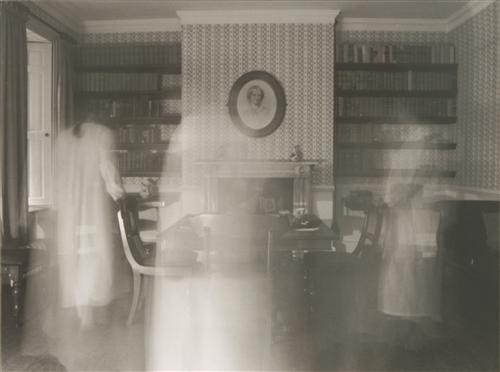
    Residual Hauntings, 2011
    Rich relates some of Bertola's past works to the ideals advocated in these manuals, including the "act[ing] out of their leisure time as a job". Bertola's Killing Time (2011) shows the artist superimposed into photographs of domestic interiors, sipping from a teacup as if caught between domestic chores. Bertola's work with images of domestic interiors seems not to clearly differentiate between images of labour and leisure. It is interesting to consider Rich's reading of Bertola's work in relation to the writing of Erving Goffman. In his explorations of the “presentation of self in everyday life”, Goffman (1959, p. 69) identifies “backstage” events and locations, in which individuals engage in private activities in preparation for the everyday performance of self. The home is divided into spaces that are, to varying degrees, public or private. Bedrooms and bathrooms are distinctly private, drawing rooms more public, and hallways, Bertola notes, "transition between public space and private space". Rich observes that time spent in, and caring for, those domestic spaces is also divided into public and private time. "Backstage" activities that are the work of the domestic labourer are conducted in private, as a means of preparing for the public presentation of a space.

    Killing Time, 2011
    The preparation of Bertola's work has often involved private labour, in isolated spaces, leading up to the time of completion when the public are invited into the space. Working on After the Fact (2006), she necessarily worked alone, in an abandoned building, sweeping dust from the floor to recreate patterns from eighteenth-century wallpaper. As she swept, she recorded the sounds of her labour in an audio track that now exists as a public record of her "backstage" activities. For an earlier work, Scratching at the Surface (2001), she spent 2 weeks at the top of scaffolding, isolated from the street below, scratching through layers of paint on the exterior of a building in Newcastle upon Tyne. These private preparations are intentionally similar to the "backstage" labour that takes place in domestic spaces, incorporating sweeping, dusting and cleaning, and consciously isolating, drawing on the "idea of being trapped" that she associates with domestic labour. She develops a sense of ownership during her temporary inhabitation of these spaces, and must relinquish her ownership when the work is complete and the public come swarming into her erstwhile private space.

    Scratching at the Surface, 2001

    After the Fact, 2006
    She has found that there is more privacy in the production of site-specific works than in galleries. Works produced for galleries, such as the work currently on display in the In and Out of Sight exhibition at the University of Hertfordshire, can require her private processes to be transformed into public performances. While creating her current work on the wall of the Art & Design gallery, Bertola was exposed to passing visitors, students and the other artists with whom she shares the exhibition. It is interesting to note that the subject of this work is a photograph of a private domestic space, made public through a photograph that has been published in a readily-available publication.
    Bertola and Rich's conversation often turned to the subject of time. Many of Bertola's works have involved reviving old images, revealing surfaces lost to time, or bridging the gaps between periods. Bertola describes her work as "fleeting". Her site-specific work is necessarily temporary. It often has a "fragility", like the dust of After the Fact, that can be swept away. Rich describes her "heartbreak" at imagining how easily Bertola's work can be brushed away. She draws parallels with the domestic labour that can be undone so easily, as clean spaces gather more dirt, and "the entrapment of women" in the neverending cycle of domestic chores (a cycle that is referenced in Bertola's Round and Round, 2016, in which the artist is shown endlessly setting and unsettling a table). It was unusual for her to preserve her images by placing them in a frame, as she has done for Sad Bones (2013-14), giving them a permanence that is not often present in her work.

    Preservation, and the effects of time, were foremost in her thoughts when Bertola created Everything and Nothing (2007) at the V&A. In this setting she became very aware of the rituals surrounding the presentation of collected artefacts, and the distinctions made between the labour of those who cared-for those artefacts, and those who cared for the museum's interior. She observed a hierarchy of cleaning, topped by the conservators responsible for cleaning the artefacts, skilled cleaners who are permitted to clean the plinths, and unskilled, "invisible" cleaners with responsibility for the floors. It is the unseen labour of the latter that is most directly referenced in Bertola's work, and that most fascinates Rich.

    Everything and Nothing, 2007


    Reference
    Goffman, E. (1959), The Presentation of Self in Everyday Life, New York: Anchor Books.


    Thursday, 23 March 2017

    DHeritage student successes at History Department Annual Conference

    The DHeritage Programme at the University of Hertfordshire is now in its third year, with three cohorts of part-time students working in heritage roles professionally and working, too, on new research into heritage-related issues for their professional doctorates. Campus-based DHeritage students meets for four or five bespoke heritage workshops during each academic year, and in addition they are encourage to attend three residential programmes: the Spring and Summer Schools hosted by the Doctoral College's Researcher Development Programme, and the annual History Department conference held each year in February at Cumberland Lodge in Windsor Great Park. This year, DHeritage was very well represented at the conference and what follows gives a flavour of the proceedings.


    Dorney Court at dusk, February 2017.
    We began with a pre-conference tour of Dorney Court, kindly organised by third-year DHeritage student Helen Casey. Dorney Court is one of England's finest Tudor manor houses and remains in private ownership. Our tour guide explained the layers of history and material culture contained within this extraordinary family home and the problems of upkeep. The tour offered a special glimpse into an often hidden world and a life very different to that of most of us.

    The academic sessions began with Prof John Styles' talk ‘Fashion to a Timetable: The Origins of the Modern Fashion System’. Prof Styles opened by noting that writing on fashion has proliferated as a result of Berg’s (now Bloomsbury's) publishing activity, and that much of this writing has focussed on identity. He traced this intellectual tendency back to the influence of Stephen Greenblatt’s book Renaissance Self-Fashioning: From More to Shakespeare (1980). Identity is not the only lens through which to view fashion, however. Another way to think about the history of dress and textiles is as indicative of fashionable change based on innovation and trade in textiles. Fashionable change in western dress of the early modern period is perceived as being in contrast to a sense of staticity in the rest of the world. The amount of choice allowed even to poorer women is indicated by, for example, the c. 1000 printed cottons in the Foundling Hospital collection for the years 1758-9 alone. There were annual changes in woven silks in Lyon, c. 1700 and annualised fashion made timing crucial for sales success. In 1681, the directors of the East India Company were aware that European women would prefer to buy and wear inferior silks than last year’s silk, while making a single silk could take more than four months.


    The annualised fashion cycle arose in the 17th century for three reasons:
    1. Mercantilism - Colbert promoted French manufacturing in three ways, including the removal of tax barriers, and capturing foreign markets with monopolies with the intention that Lyon would supplement Italy as the major fashion centre.
    2. Court Dress - Louis XIV's ceremonial approach to dress involved a court dress code, rituals such as the levee and the couchee, and an insistence that members of the court bought French goods. Staff who kept the King's wardrobe were interested in fashionable change because they sold the king's old clothes for personal profit.
    3. Magazines and the fashion press - It was expensive to print images, although they were the best medium for the dissemination of fashion.
    Next, Dr Ceri Houlbrook presented her fascinating project 'Concealed Revealed: Material Objects Hidden in Walls':
    A hidden shoe up a chimney breast. A mummified cat in the roof space. A child’s cap in a wall cavity. A horse skull under the floorboards. These are just some of the secret objects people have discovered when renovating their homes – undoubtedly quite surprising finds considering the odd (indeed, sometimes quite disturbing) nature of the objects, coupled with their unusual locations.
    Read more about Ceri's research in her project blog: https://theconcealedrevealed.wordpress.com 

    Saturday morning began with two presentations, Emma Battell Lowman & Adam J Barker's 'Writing History in the Settler Colonial Present' and Paul Lynch, ‘Behind the Curtain: A Glimpse of Life in East Berlin.' Paul's talk ranged from details of the complex security of the Berlin Wall, to amazing archive of photographs taken by the Stasi so that after searching people's homes, they could put the things back in the same places and erase any evidence of their searches. Photographs in this archive include a Western coffee maker, which was at once grounds for suspicion and a source of refreshment, a US serviceman’s coat, posters of the pop star Madonna, and an unmade bed. Lynch also discussed the Oscar-winning 2006 film The Lives of Others, writer-director Florian Henckel von Donnersmarck's story of Stasi officer Gerd Wiesler. 


    The presentations continued with Simon Langsdale's 'St Albans is dying in a blaze': Bribery, Corruption, Theft and Embezzlement in a Hertfordshire Market Town 1835 - c.1853' and Bridget Long's, 'London Asylum for Girls (Asylum for Orphans and other Deserted Girls of the Poor) and their needlework training in the second half of the eighteenth century.' Long began with the observation that the weaver could weave thread faster than the spinner could spin. Spinning was therefore the biggest occupation for women in early modern England, occupying 1.5 million women. Impoverished girls taken in by the Foundling Hospital were taught to spin, while their male counterparts were sent off to the Navy. Economic historians have had difficulty quantifying the amount that spinners spun, and we don’t know how well they were paid. Trimmer, writing on the 'oeconomy of charity' had a school of industry in which industry meant spinning.


    The Spinstress, 1782-6, by George Romney, of Emma Hart, later Lady Hamilton, Lady Nelson

    Saturday afternoon saw two DHeritage sessions punctuated by Dr Friedrich (Rudi) Newman's talk '"Hoy, Hoy, Where are you coming to?" – The Great Thames Disasters', in which he shared research which forms a chapter of his new book and made the audience concerned about the safety of their own excursions on the water!  

    Memorial card for the Princess Alice which sank near Woolwich, September 3rd, 1878

    Four DHeritage students presented their doctoral research in the final panel of the day: first years Sarah Buckingham and Janine Marriott, second year student Charlotte Reynolds, and Helen Casey, who is in her third part-time year of study.  

    DHeritage students (L-R) Charlotte Reynolds, Helen Casey, Janine Marriott and Sarah Buckingham
    In her presentation, 'Public Engagement with and attitudes to sites of memorial, death and remembrance. A toolkit for Public Engagement' Janine Marriott explained how sites of burial, memorialisation and remembrance have long been associated with learning and public engagement, from the Victorian Garden Cemetery and its ‘improving influence’ through to modern day visits to battlefields for enthusiasts, or school trips to Auschwitz for study of world history. Although increasingly popular and acceptable heritage destinations, such sites are not always included when research is undertaken or studies are published in the heritage field. These sites are not traditional heritage venues like stately homes, museums, galleries or archives but often comprise elements of these and heritage models can be partially applied to them. Increasingly sites of remembrance such as cemeteries, battlefields, prisons, former concentration camps, or even places where an event like the September 11th attacks occurred, are becoming firmly established as part of the heritage landscape.

    Janine's study of a range of memorialisation sites seeks to gather together the different ways that people learn and experience these sites and how they interact with what can be extremely challenging and provoking places. Such places are often labelled ‘Dark Tourism’ or ‘challenging history’ because death is a major theme and is regarded as taboo. Among specific heritage communities there is, therefore, a growing array of experience and learning, but no pooled body of knowledge. Janine will explore a number of case studies, and produce resources and research that can be used to advise and support such venues when engaging the public.

    Sarah Buckingham asked 'How might the major crisis for heritage in Syria prompt a reconsideration of both our principles and practical approaches for major interventions to rehabilitate heritage sites in response to war, natural disaster or following extensive abandonment or dereliction?' The question is posed with particular reference to the involvement of traditional trades and crafts in rehabilitation works, and how that might affect concepts of authenticity and integrity. The debate prompted by the destruction of major monuments and world heritage sites in Syria and elsewhere in the Middle East by the “Islamic State” or as a by-product of conflict has the potential to prompt a significant reconsideration of contemporary approaches to heritage and its conservation, raising questions as it does particularly about the concept of 'authenticity', and how that influences its treatment. Questions of whether to reconstruct destroyed or partially destroyed sites rest heavily on the issue of authenticity – that is, it is implied, the importance of largely or wholly original fabric in something like its original disposition. Where sites have been blow up and cleared by bulldozer, the argument goes, authenticity can lie only in the fragmented remains. Many historic buildings and places, including key archaeological sites in Syria, have often been the subject of considerable interventions both historically and in the more recent past and the apparent authenticity may be in part illusory – this is not always factored into this argument.

    Helen Casey's research explored 'Digital decisions – lessons from the recent past about using the technology of the future'. Around 2000, Helen told us, heritage writers made predictions, positive and negative, about the digital future. Some argued that heritage would be democratised through access to all. Others despaired that we are creating a digital black hole into which all of our data will disappear. Gordon Reid's article 'The Digitisation of Heritage Material' (2000) is apposite here. Writers compare the advent of the internet with that of the printing press. Helen reviewed the ideas of Peter Haddad, director of the technical service branch of the national library of Australia (2001), Ross Parry's 'Recoding the Museum: Digital Heritage and the Technologies of Change' (2007) and Dr Ruth Taylor of the National Trust, writing in Alison Hems and Marion R. Blockley's edited collection Heritage Interpretation (2006). Helen has a raft of questions about digitisation: Have people cooperated or worked in their own silos? What has ended up online – democratisation or black hole? What about interpretation, what information surrounds the digital objects? Are virtual visitors the same as real ones when museums still need footfall. Factors determining digitisation include cost, time, expertise, fear of obsolescence, etc. She plans a series of semi-structured interviews with heritage professionals and her method will blend grounded theory with narrative analysis, and policy analysis.

    This panel closed with a presentation by Professor Rebecca Houze, TVAD Research Group Visiting Researcher for 2016-17. Prof Houze shared her research into the US National Parks Service. This project examines the European origins of the US National Park Service Rustic buildings within a broader context of industrialization and travel, looking specifically at the transatlantic relationship between Europe and North America that developed in the nineteenth century. It takes as its model and point of departure art critic Rosalind Krauss’s influential 1979 essay, 'Sculpture in the Expanded Field,' which seeks to understand Earthworks, such as the large-scale environmental projects by Robert Smithson, Nancy Holt, and others during that period, as a new form of sculpture. Likewise we may think of the lodges, camps, train depots, trails, roads, gateway entrances, and other structures in the United States National Park Service Rustic Style, built between the period of the turn-of-the century lodges and the modernizing upgrades of the Mission 66 program after World War II, collectively as an 'open air museum.' The key characteristics of the open air museum are its self-conscious situation and dramatic presentation in the landscape in the form of architecture and staging of transportation routes; its deliberate juxtaposition of primitive with civilized, above all, through the evoking of a lost or disappearing indigenous past, signified by native flora, fauna, and peoples; and in the US context, its didactic, mythologized narrative of American national identity by constructing and dramatizing the landscape as antiquity and place of origin.


    Prof Rebecca Houze discussing the visual presentation of the US National Parks

    The project identifies common structural features of the open-air museum, particularly in its manifestation as National Park in the United States. It begins with a meditation on lodges and camps as places to stay within the parks, and their broader relationship to other dwelling types, including the log cabin, rural farmhouse, and tent. The best-known rustic lodges were developed after the prominence of grand resort hotels in the last part of the nineteenth century, many of which were modelled on aristocratic Victorian prototypes. The early twentieth-century examples, by contrast, incorporated native building materials, and forms appropriate to the cultural and climatic traditions of the regions that they represented. The lodges of Yellowstone, Yosemite, Glacier, Mt. Rainier, and the Grand Canyon explore a new American architecture with roots in the Shingle and Stick Styles, as well as the British Arts and Crafts tradition. These modes are related both to a nostalgia for the log cabin, associated with the self-sufficiency of the pioneer against hostile nature, as well as with the moral and intellectual achievements in American political life, as in the case of President Abraham Lincoln’s own humble beginnings in his childhood log cabin. While connected to the log cabin on the American side of the Atlantic, the lodges also draw upon romantic European perceptions of the wooden farmhouse, and in particular the Scandinavian and Alpine chalet, which had been popularized as a charming, fanciful form of building in both Europe and North America for much of the nineteenth century. This association, easily seen in the many treatises on landscape architecture and domestic dwellings published during that period by Andrew Jackson Downing and Henry Hubbard, is complicated by the fact of European immigrant carpenters who were employed to construct and furnish the new lodges in the park, suggesting possibly closer connections between the European and American structures. Much less is known about the workers themselves than the architects who designed and concession companies who financed these buildings.

    The day ended with a screening of Tim Slade's powerful film The Destruction of Memory (2016), introduced by Sarah Buckingham, who also chaired a group discussion afterwards. The film includes interviews with the Director-General of UNESCO, the Prosecutor of the ICC, and international experts across various disciplines. The following group discussion centred on what is worth saving, hierarchies of value, and authenticity and inauthenticity in reconstruction processes.


    Robert Bevan in The Destruction of Heritage, dir. Tim Slade
    On Sunday morning some members of the group attended services at the Royal Chapel in the grounds of nearby Royal Lodge while others participated in a practical workshop on writing and publishing academic articles followed by a postgraduate student talk on completing and submitting your thesis. In the final session we played the 'impact game' which encouraged us to think about new ways to engage different audiences with our research. 

    DHeritage staff and students closed the weekend with a short walk around the Cow Pond, and looked ahead to next year. The History Department conference this year saw a wealth of information shared about material culture, not only in the papers presented by DHeritage students and by Prof Rebecca Houze for TVAD, but also by the members of the History Dept. who are not directly involved with the DHeritage Programme. The material turn is apparently in full effect at the University of Hertfordshire!